In real-world conditions, an analyst is not looking for an confidence interval for every single candidate but rather a shortlist of candidates from this massive pool; individuals of this pool posses unobserved true outcomes that exceed a threshold .
Scenarios where false positives are very costly such as drug discovery or financial fraud, ensuring the False Discovery Rate (FDR) is controlled becomes very important.
Naively, one might use conformal prediction to select based on . However this is an issue as marginal coverage only guarantees the average across the entire dataset not within our shortlist.
A solution is the Bonferroni correction which which upper bounds the FDR below . However the issue, is that the bar is set so high that the model loses its power (ability to avoid a Type II error). Thus we require a new solution.
Random Hypothesis Testing
Here is our null hypothesis whereas our true outcome is when which means our candidate is a true discovery. Our set of true nulls is defined as . Note that unlike traditional testing around around a fixed hidden population parameter, a unobserved future random variable is used, thus it is called predictive / random hypothesis testing.
Conformal P-Values
We define a nonconformity score function which outputs how poorly an outcome conforms to what the model expects at a feature state . The model is trained independently of both the calibration and test samples, thus it is fixed and given. For example: which is the absolute residual.
Now assume that we are able to observe and thus have . You are also able to calculate the nonconformity scores for all known calibration data: for .
Define.
which we can call the Oracle Conformal P-Value which requires known the true unobserved test outcome .
is a random draw from a uniform distribution between 0 and 1 () which resolves the problem when there are scores exactly equal to . This causes us to achieve valid p-values: . For example, supposed but our dataset only allows p-values to be or , thus we round up to which causes us to lose statistical power.
Now to resolve the problem of not knowing , we need to use monotone nonconformity score functions.
Define.
A nonconformity score is monotone if holds for any and any obeying .
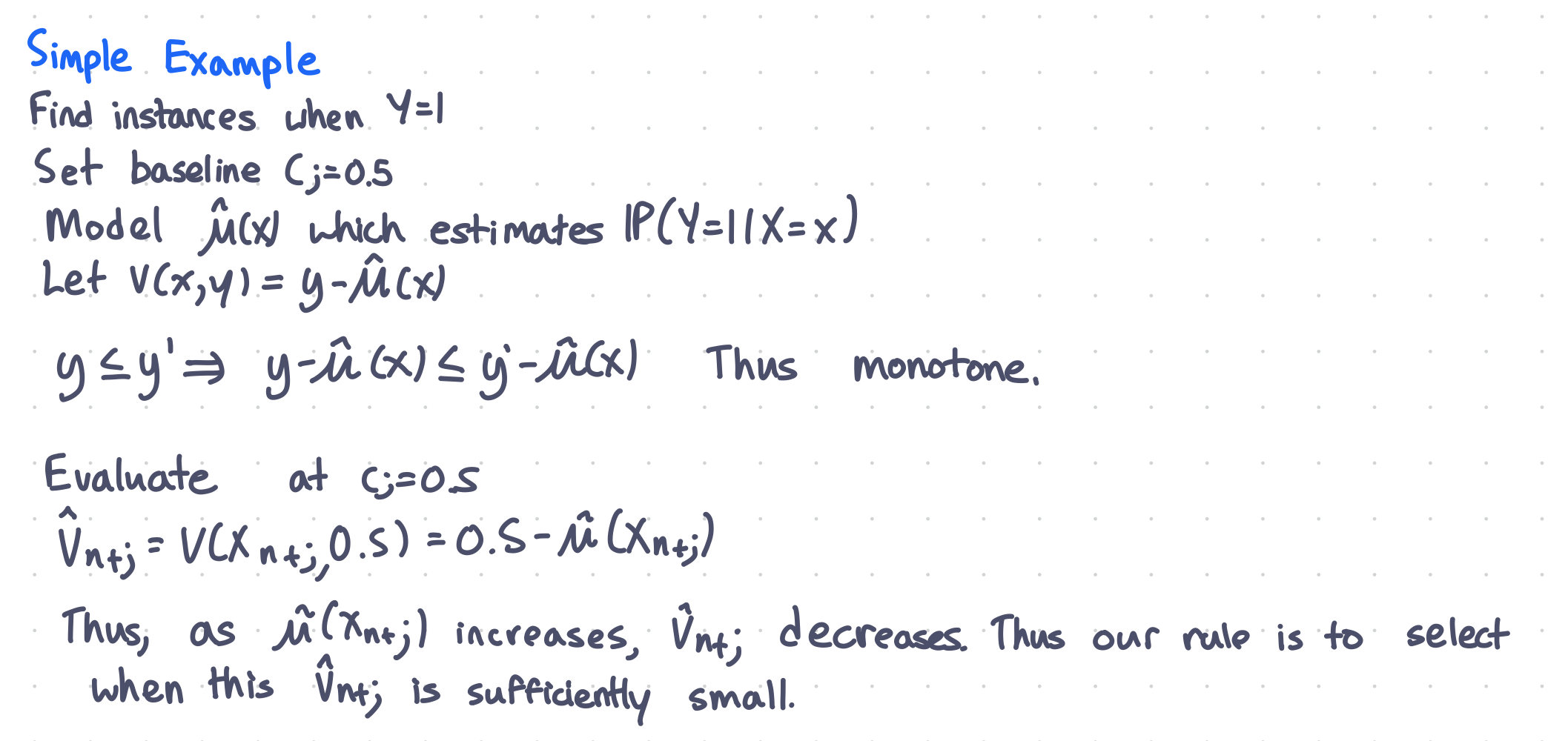
Instead of evaluating at the test score at the unknown , we evaluate at threshold .
Define.
where
This is called the observable conformal p-value.
The monotonicity is important because knowing . When we have a larger score, it will be larger then more calibration points, thus the numerator grows. Thus naturally .
An inflated p-value is conservative and thus when we swap for observable , the number of false discoveries is non-increasing.
Intuitively, it means we are at least confident that and quantifies how extreme the threshold is to the usual behaviour of outcomes.
Now, we need to process these conformal p-values to translate individual confidence scores to a shortlist of candidates.